
What Is Your Window of Tolerance — and Why Does It Matter?
Have you ever noticed that sometimes you can handle a difficult conversation, a stressful day, or an unexpected problem reasonably well… and other times something relatively small feels like way too much?
That doesn’t necessarily mean you’re overreacting.
It may mean you’ve moved outside of your window of tolerance.
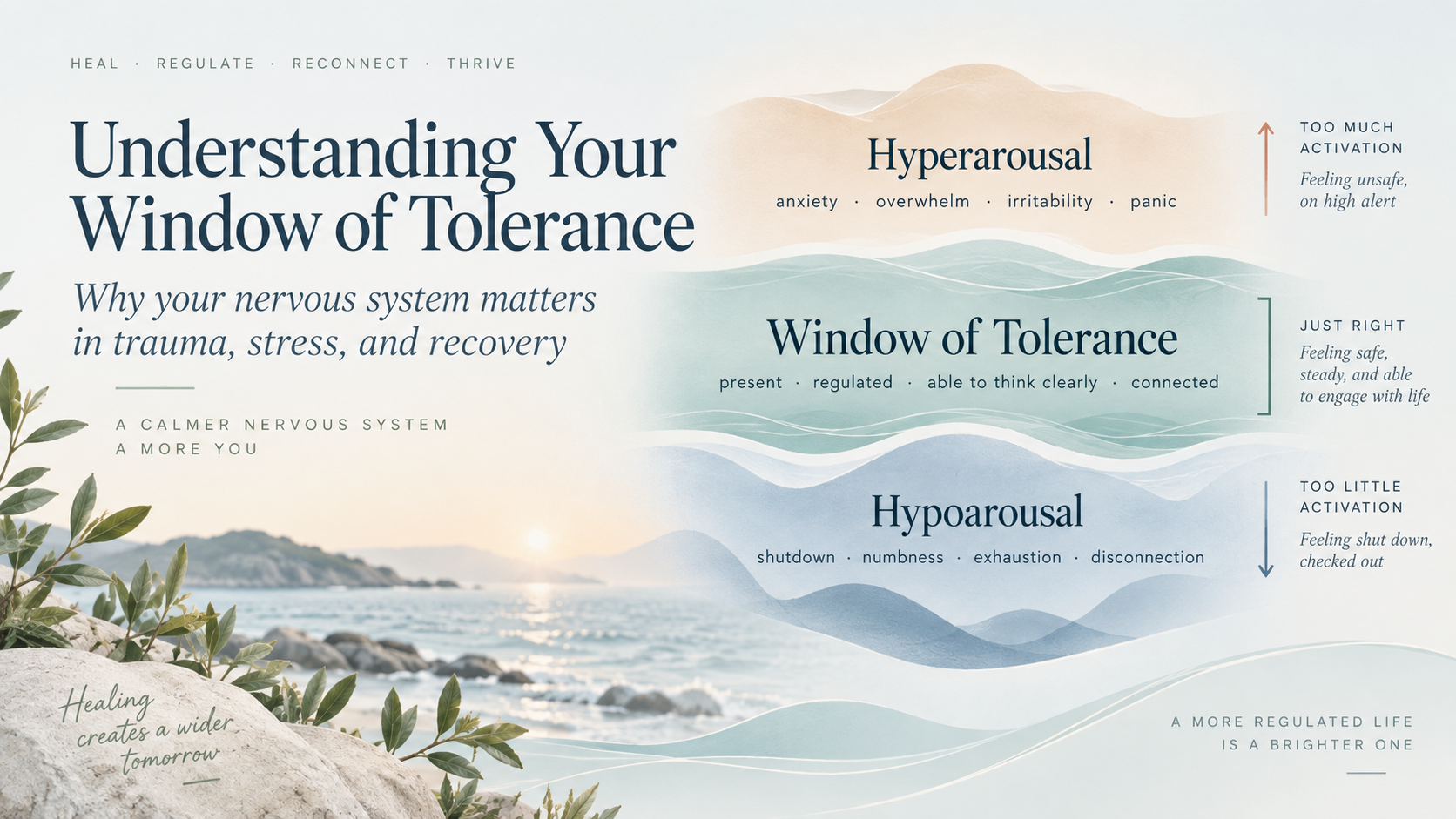
The window of tolerance is a simple way of understanding the range in which your nervous system feels regulated enough to stay present, think clearly, feel your emotions, and respond to what is happening instead of just reacting to it.
When you’re inside your window, you still get stressed. You can still feel sad, angry, anxious, disappointed, or overwhelmed. The difference is that you have enough capacity to stay connected to yourself while you’re feeling it.
You can think.
You can make choices.
You can communicate.
You can tolerate discomfort without immediately needing to escape it, shut it down, numb it, fix it, or make it go away.
That’s regulation.
And one of the biggest misconceptions about nervous system work is that the goal is to feel calm all the time.
It isn’t.
The goal is to have a wider capacity for being human.
What happens when you move outside your window?
When the nervous system perceives that something is too much, it may move into hyperarousal.
This can look like:
Anxiety
Irritability
Anger
Racing thoughts
Panic
Restlessness
Feeling emotionally flooded
Hypervigilance
Difficulty concentrating
An urge to control, fix, escape, use substances, shop, scroll, overwork, or otherwise get relief
For some people, the nervous system moves in the opposite direction into hypoarousal.
That may look more like:
Shutting down
Numbness
Exhaustion
Dissociation
Feeling disconnected from your body
Difficulty thinking or speaking
Wanting to sleep or disappear
Feeling emotionally flat
Avoiding people or responsibilities
And sometimes we move back and forth between the two.
You can be anxious and activated all day and then completely shut down at night.
You can look incredibly high functioning from the outside while your nervous system is working overtime underneath it all.
That is especially common in people who have spent a long time surviving by being productive, capable, responsible, or in control.
Your window is not fixed
This part is really important.
Your window of tolerance is not a personality trait.
It changes.
Sleep, hormones, physical illness, grief, relationship stress, trauma triggers, work pressure, alcohol, substances, hunger, chronic stress, and even how much stimulation you’ve had that day can all affect how much capacity you have.
Something you handled beautifully last week may completely overwhelm you this week.
That doesn’t necessarily mean you have gone backward.
It may mean your nervous system has less available capacity right now.
And if you have a trauma history, chronic stress, addiction history, or years of living in survival mode, your window may have become relatively narrow.
Your system has learned to react quickly because at some point, reacting quickly was useful.
The problem is that your nervous system doesn’t always know the difference between what was dangerous then and what feels threatening now.
This is where trauma work becomes more than “talking about it”
Insight is important.
Understanding why you react the way you do can be incredibly helpful.
But you can understand your trauma intellectually and still have your body react as though the danger is happening right now.
That is why I often tell clients that healing is not just about knowing your story.
It is about helping your nervous system have a different experience.
Over time, effective trauma work can help increase your capacity to stay present with difficult emotions, memories, relationships, and sensations without becoming completely overwhelmed or shutting down.
That may happen through EMDR, mindfulness, somatic work, breathwork, yoga, grounding, attachment work, and practicing regulation in real-life situations.
The goal is not to eliminate activation.
The goal is to build enough capacity that activation doesn’t have to run the show.
And this matters tremendously in addiction and compulsive behavior
When we look at addiction only as a problem with a substance or behavior, we miss something important.
Very often, the substance or behavior has been functioning as a regulation strategy.
Alcohol may quiet the nervous system.
Stimulants may pull someone out of collapse.
Shopping may create temporary relief.
Food may soothe.
Overworking may help someone avoid feeling.
Scrolling may numb.
Controlling everything may create the illusion of safety.
So if we simply remove the coping mechanism without helping someone expand their ability to tolerate what is underneath it, we haven’t fully addressed the problem.
Recovery is not only about learning how not to use.
It is also about developing the capacity to stay with yourself when your nervous system wants desperately to get away from what you’re feeling.
That is deeper work.
A useful question to start asking
Instead of immediately asking:
“What is wrong with me?”
Try asking:
“What is happening in my nervous system right now?”
Am I activated?
Am I shutting down?
What happened before this?
What does my body feel like?
What am I wanting to do to get away from this feeling?
And what might help me come back into enough regulation that I can choose what happens next?
Sometimes the answer is movement.
Sometimes it is slowing down.
Sometimes it is breathing.
Sometimes it is connection.
Sometimes it is getting outside.
Sometimes it is eating, sleeping, crying, setting a boundary, or deciding that today is not the day to have the difficult conversation.
And sometimes the pattern is deep enough that you need more than a few coping skills.
That is where trauma therapy can help.
The goal is not to become less sensitive
I think this is worth saying clearly.
Healing does not mean becoming unaffected by life.
It does not mean nothing bothers you anymore.
And it does not mean you become perfectly regulated.
It means your system becomes more flexible.
You can feel activated without immediately spiraling.
You can feel pain without immediately numbing it.
You can experience conflict without automatically assuming the relationship is unsafe.
You can notice an urge without having to act on it.
You can leave your window of tolerance and learn how to come back.
That is what nervous system healing begins to look like in real life.
And over time, that window can get wider.
You have more room to feel.
More room to choose.
And more room to actually live your life instead of constantly managing your nervous system.
If you notice that you understand your patterns but still feel stuck in the same emotional, trauma, or recovery loops, deeper trauma work may be helpful.
This is much of the work I do through trauma and addiction therapy and therapeutic intensives: creating enough time and space to move beyond simply managing symptoms and begin working with the patterns underneath them.
You can learn more about my work at lorilauridsen.com.